不是实验室原型,不是整机分析仪。而是一个紧凑、校准过的 TDLAS 模块,插入你的设备即可交付可靠的气体浓度数据。
Specvaltech designs and manufactures Line A (compact OEM, ±2% FS, 0–100% CH₄) and Line B (pipeline insertion, 20–200 kPa abs, Ex ia I Ma target) modules based on Tunable Diode Laser Absorption Spectroscopy. We are a component supplier — you integrate our module into your instrument; we handle the measurement physics, calibration, and field reliability.
Building gas measurement into your instrument from scratch means solving physics, optics, signal processing, and field certification — all at once. Most teams run into the same six walls.
Vibration, temperature swings, and condensation degrade optical alignment and baseline stability. NDIR sensors drift. Electrochemical cells age. Your warranty claims multiply.
Coal mine drainage headers, biogas digesters, and vacuum extraction lines run at 20–80 kPa absolute. Most sensors are rated for positive pressure only. Sampling pumps add complexity and failure points.
Sourcing a DFB laser, TEC controller, absorption cell, and 2f/1f lock-in amplifier separately — then integrating them — consumes engineering time that should go into your product’s core value.
Ex ia I Ma (intrinsic safety, Group I, Category Ma) requires entity parameter documentation, barrier coordination, and type examination. Getting this wrong delays market entry by 6–12 months.
Cross-sensitivity to CO₂, H₂O, and other hydrocarbons corrupts CH₄ readings. NDIR broadband absorption cannot distinguish overlapping spectral lines without expensive optical filters.
Customers expect zero-maintenance operation. But without a structured calibration protocol and baseline drift correction, “no consumables” becomes “no confidence in readings.”
We are a component supplier, not a system house. Our customers are the people who build instruments, integrate systems, or operate infrastructure at scale.
You need a measurement node that fits your enclosure, speaks your protocol (UART / Modbus / 4–20 mA), and arrives calibrated. Line A is designed for this.
You need a sensor that survives the installation environment — negative pressure, vibration, explosive atmosphere — without a sampling pump or conditioning system. Line B is designed for this.
You need technical documentation, entity parameters, and a sample unit before committing to a production order. We support evaluation with full specification disclosure and application engineering.
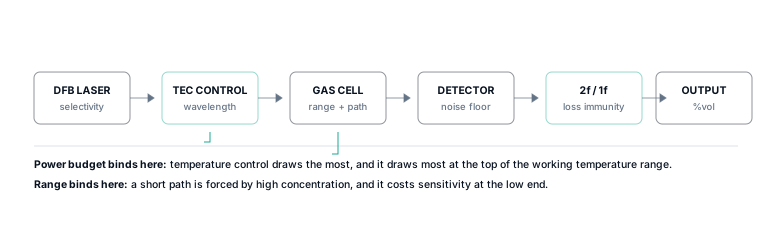
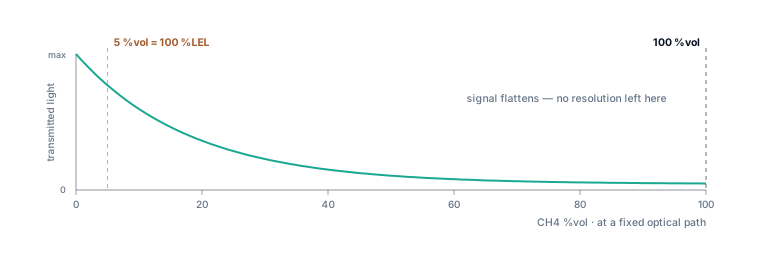
TDLAS uses a single-frequency DFB laser tuned to a gas-specific absorption line. The result is a measurement that is inherently selective, drift-resistant, and free of consumables.
The laser wavelength is locked to one absorption line of the target gas. CO₂, H₂O, and other hydrocarbons cannot produce false positives — their lines are at different wavelengths.
Wavelength modulation spectroscopy divides the second-harmonic signal by the first-harmonic carrier. Laser power fluctuations and window contamination cancel out of the ratio.
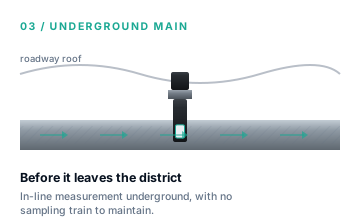
Line B uses a probe inserted directly into the pipeline. Gas flows past the optical path naturally. No pump, no filter, no moving parts in the measurement chain.
No electrolyte, no membrane, no reference gas cylinder. Calibration drift is dominated by optical path length stability — a mechanical parameter, not a chemical one.
Line A and Line B share the same TDLAS measurement core. They differ in form factor, pressure range, and integration interface — to match the two most common OEM scenarios.
A self-contained TDLAS measurement node with a 10 cm absorption cell, integrated DFB laser and TEC, and a calibrated digital output. Designed to be embedded inside your instrument — not bolted on the outside.
A probe-style TDLAS module that inserts directly into the pipeline. Operates at 20–200 kPa absolute — covering the full range of coal mine drainage headers and biogas extraction systems. No sampling pump required.
Each application has specific pressure, accuracy, and certification requirements. Our modules are specified to match — not adapted from a general-purpose sensor.
CH₄ monitoring at the main drainage header. Pressure: 20–80 kPa abs. Safety interlock threshold: 30% LEL typical. Line B direct insertion, no pump.
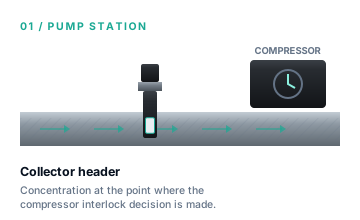
See full application →Monitoring at the pump inlet to protect equipment and verify extraction efficiency. Pressure: 40–120 kPa abs. Fast response (<10 s T90) for pump interlock.
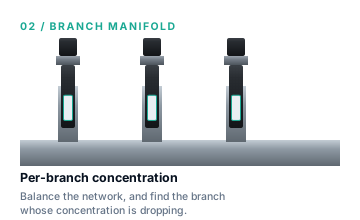
See full application →Per-branch measurement to identify high-yield seams and detect dilution. Pressure: 20–60 kPa abs. Multiple points require compact, low-cost modules.
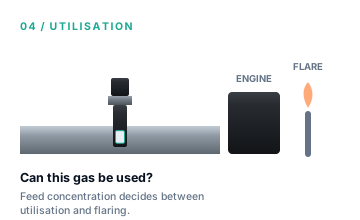
See full application →CH₄ purity verification before combustion engine or CNG compressor. Pressure: 80–200 kPa abs. Accuracy: ±2% FS for fuel-value billing.
See full application →You describe your gas, pressure range, accuracy requirement, and integration interface. We confirm module fit or flag a mismatch.
We issue a formal specification sheet with entity parameters, interface drawing, and calibration certificate format.
We ship a sample module with integration documentation. Your team integrates and validates against your instrument’s requirements.
Series production with batch calibration certificates. We support your type examination with entity parameter documentation.
A side-by-side comparison of measurement physics, drift behaviour, cross-sensitivity, and OEM integration cost for CH₄ detection applications.
Read article →Pressure correction, sampling system design, and why direct-path TDLAS eliminates the pump problem in coal mine drainage applications.
Read article →Interface protocol, power budget, optical path contamination, calibration interval, and entity parameter coordination.
Read article →We don’t send a product catalogue. We review your gas, pressure, accuracy, and integration requirements and give you a specific module recommendation with entity parameters.
Module fit confirmation — Line A or Line B, with reasoning based on your pressure range and installation type.
Accuracy budget check — We calculate the expected error band at your operating conditions, including pressure correction.
Integration interface confirmation — Protocol, power, and mechanical fit against your instrument’s requirements.
Certification path — If you need Ex ia I Ma, we outline the entity parameter documentation we provide for your type examination.
Senior Engineer Zhao
Application engineering & OEM integration
📱 WeChat / Mobile: +86 189 7107 8447
💬 WhatsApp: +86 189 7107 8447