What is TDLAS? Tunable Diode Laser Absorption Spectroscopy is a high-resolution optical measurement technique. It uses a narrow-band laser to scan a single absorption line of a target gas molecule, providing absolute concentration data with zero cross-sensitivity.
The Physics of Selectivity
Every gas molecule has a unique "fingerprint" of absorption lines in the infrared spectrum. TDLAS uses a Distributed Feedback (DFB) laser that is so narrow it only "sees" one specific line. Unlike NDIR, which uses a broad light source and filters, TDLAS selectivity is determined by the laser wavelength itself.
Wavelength Modulation Spectroscopy (WMS)
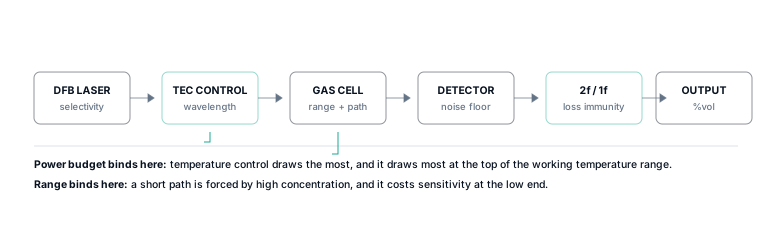
Specvaltech modules use 2f/1f WMS to achieve field-leading stability. By modulating the laser frequency and detecting the second harmonic (2f), we can eliminate the baseline (1f) noise caused by laser power fluctuations or dirty windows.
Why it beats NDIR in OEM instruments
- No drift: The measurement is referenced to a physical constant (absorption line wavelength).
- No poisoning: The sensor never touches the gas; only the light does.
- Humidity immunity: Water vapour lines are easily avoided by choosing the right laser wavelength.