Challenge: Monitoring methane in coal mine drainage pipelines requires sensors that can withstand high humidity, dust, and negative pressure (suction) without frequent maintenance or pump failures.
The Four Nodes of Gas Drainage
Effective methane monitoring in a coal mine requires measurement at four distinct nodes. Each presents a unique challenge that TDLAS is uniquely suited to solve.
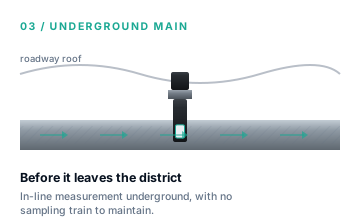
1. Underground Main Header
Large diameter pipes collecting gas from multiple working faces. High volume, high moisture.
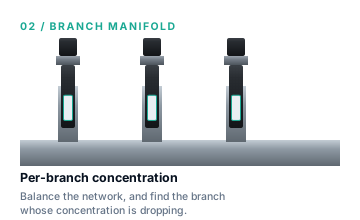
2. Branch Manifold
Where individual boreholes meet. Critical for identifying which zone is producing gas.
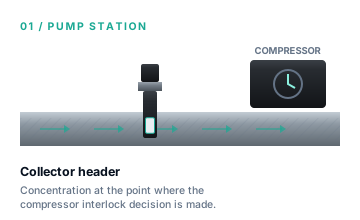
3. Surface Pump Station
The heart of the drainage system. Vacuum pressure can drop to 20 kPa absolute.
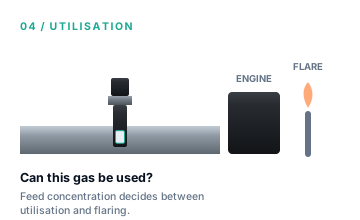
4. Gas Utilisation
Monitoring the quality of gas sent to power plants or flares.
Why Line B is the Standard
By inserting the Line B probe directly into the pipe, mine operators eliminate the sampling system entirely. No pumps to burn out, no filters to clog with coal dust. The 2f/1f signal processing ensures accuracy even if the probe window becomes partially obscured.