How do you prepare an OEM gas analyser for ATEX/IECEx type examination? When integrating a TDLAS module into an intrinsically safe instrument, the OEM must manage the system-level certification. The module supplier provides the necessary entity parameters (Ui, Ii, Pi, Ci, Li) and documentation (BOM declarations, thermal test data) to prove the measurement node complies with Ex ia standards. The OEM uses these parameters to perform the spark ignition and thermal assessment for the complete instrument, ensuring the total capacitance and inductance of the interconnected system remain within safe limits.
1. Understanding the certification boundary
When designing a gas analyser for hazardous areas—such as underground coal mines (Group I) or petrochemical plants (Group II)—the final instrument must undergo type examination by a Notified Body to receive ATEX, IECEx, or local (e.g., MA, GOST) certification.
A common misconception among instrument manufacturers is that they can buy a "pre-certified" OEM module, drop it into their enclosure, and automatically inherit the certification. This is legally and technically incorrect.
The OEM module is a component. The certification boundary applies to the complete, finished instrument. As the instrument manufacturer, you hold the certificate. Specvaltech's role is to provide a module designed to intrinsic safety standards and to supply the documentation you need to pass your system-level assessment.
2. Intrinsic safety parameters (The Entity Concept)
For an instrument to be certified as intrinsically safe (Ex ia), it must be incapable of releasing enough electrical or thermal energy to ignite an explosive atmosphere, even under double-fault conditions.
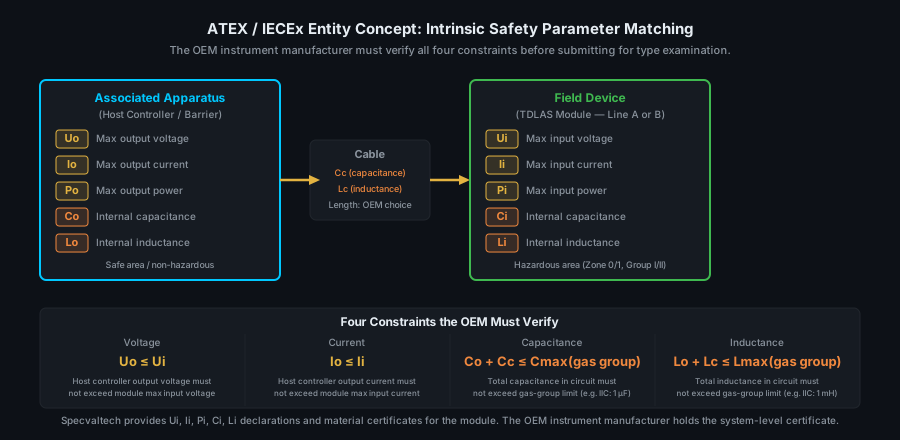
When you integrate a Line B module, you must connect it to your host controller. The Notified Body will evaluate this connection using the Entity Concept. Specvaltech provides the following parameters for the module's interface:
- Ui (Maximum input voltage): The highest voltage the module can safely receive.
- Ii (Maximum input current): The highest current the module can safely receive.
- Pi (Maximum input power): The highest power the module can safely dissipate.
- Ci (Internal capacitance): The unprotected capacitance inside the module.
- Li (Internal inductance): The unprotected inductance inside the module.
Your job as the OEM is to ensure that your host controller's output parameters (Uo, Io, Po) do not exceed the module's input limits (Ui, Ii, Pi), and that the total capacitance and inductance of the circuit (including the connecting cable) remain below the allowed limits for the target gas group.
3. Mechanical and material pitfalls
Electrical energy is only half the assessment. The Notified Body will also scrutinise the mechanical design. Common pitfalls that delay certification include:
- Light alloy restrictions: For Group I (mining) equipment, the use of aluminium, magnesium, titanium, and zirconium is strictly limited to prevent frictional sparking. Specvaltech modules are constructed from compliant materials (e.g., specific grades of stainless steel or brass), and we provide the material declarations required by the assessor.
- Static charge accumulation: Non-metallic parts (like plastic enclosures or labels) must not accumulate dangerous levels of static electricity. If you enclose the Line A module in a plastic housing, you must ensure the housing material meets the surface resistance requirements of IEC 60079-0.
- Clearance and creepage: The physical distance between intrinsically safe circuits and non-intrinsically safe circuits (or earth) must meet strict minimums. Our modules are designed with these PCB layout rules in mind.
4. The documentation package
To support your type examination, Specvaltech provides an integration documentation package under NDA. This typically includes:
- Entity parameter declarations.
- Material certificates for exposed metallic parts.
- Maximum surface temperature data (to support your Temperature Class assessment).
- Laser safety classification reports (confirming the optical power is below the ignition threshold for the target gas).
5. Conclusion
Preparing for type examination should begin during the initial hardware architecture phase, not after the prototype is built. By selecting a TDLAS module that is designed from the ground up for intrinsic safety, and by working with the entity parameters from day one, you can ensure a smooth, predictable path through the certification process.
Preparing for ATEX/IECEx/MA certification?
Let us know your target certification standard and gas group. We will provide the relevant entity parameters and material declarations for the module to support your system assessment.