How does negative pressure affect TDLAS gas measurement? Gas drainage networks operate under negative pressure (suction). According to the Beer-Lambert law, lower pressure means lower molecular density, which reduces light absorption and causes uncompensated sensors to report falsely low gas concentrations. Furthermore, lower pressure narrows the gas absorption linewidth (pressure broadening effect). To measure accurately under negative pressure, a TDLAS module must dynamically measure the sample pressure and algorithmically compensate both the expected molecular density and the expected absorption line shape across the entire operating envelope (e.g., 20–200 kPa absolute).
1. The reality of gas drainage networks
Most OEM gas sensors are calibrated and tested at standard atmospheric pressure (approximately 101.3 kPa absolute). In many industrial applications, this is sufficient because the sample gas is drawn into the analyser and vented to the atmosphere, maintaining a near-ambient pressure inside the measurement cell.
However, coal mine gas drainage networks operate differently. The purpose of the network is to extract methane from underground coal seams before mining operations begin. To achieve this, massive surface vacuum pumps apply suction to the entire underground pipeline network.
This means the gas inside the pipeline is under significant negative pressure—often ranging from -20 kPa to -80 kPa gauge (approximately 80 kPa to 20 kPa absolute). If you are designing an instrument that measures gas directly in these pipelines, you are designing for a negative pressure environment.
2. The physics: why readings drop when pressure drops
Optical gas measurement, including TDLAS, relies on the absorption of light by gas molecules. The fundamental principle is the Beer-Lambert law, which states that absorbance is proportional to the concentration of the absorbing species and the path length of the light.
Crucially, "concentration" in the Beer-Lambert law refers to number density (molecules per unit volume), not volumetric percentage (%vol).
When the pressure drops from 100 kPa to 50 kPa, the gas expands. The volumetric percentage of methane might still be 50 %vol, but the actual number of methane molecules in the optical path has been halved. An uncompensated sensor will simply see less absorption and report a reading that is 50% lower than the true volumetric concentration.
3. The second effect: pressure broadening
If molecular density was the only variable, pressure compensation would be a simple linear multiplier. Unfortunately, pressure also affects the shape of the absorption line itself.
At higher pressures, gas molecules collide more frequently. These collisions perturb the energy states of the molecules, causing the absorption line to widen—a phenomenon known as collisional broadening or pressure broadening.
Conversely, under negative pressure, collisions are less frequent, and the absorption line becomes narrower and sharper. TDLAS modules scan across this line shape. If the signal processing algorithm expects a broad line (calibrated at 100 kPa) but encounters a narrow line (operating at 50 kPa), the area calculation will be incorrect. Effective pressure compensation must adjust for both density changes and line shape changes simultaneously.
4. Mechanical containment vs. algorithmic compensation
When evaluating a gas module for a negative pressure application, instrument engineers must distinguish between two different specifications:
- Mechanical Pressure Envelope: This indicates the physical pressure the module's enclosure, seals, and windows can withstand without leaking or breaking. A module might be rated to survive -80 kPa gauge pressure mechanically.
- Compensated Measurement Envelope: This indicates the pressure range over which the module will output an accurate, compensated %vol reading.
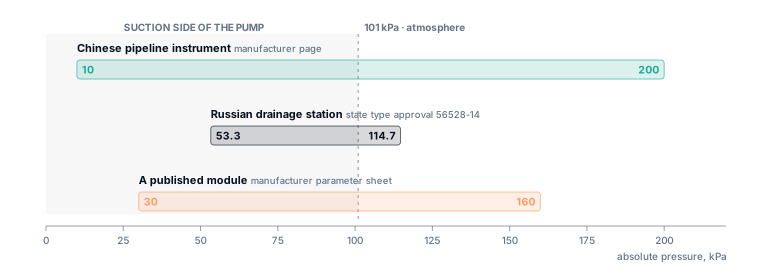
Many standard sensors have a wide mechanical envelope but a narrow compensated envelope (e.g., 80–120 kPa absolute). If installed in a drainage pipeline operating at 50 kPa absolute, the sensor will not break, but its readings will be entirely incorrect.
5. Specvaltech's approach to negative pressure
Specvaltech's Line B pipeline insertion module is designed specifically for gas drainage applications. It addresses the negative pressure challenge through a combination of hardware and algorithmic design:
Integrated absolute pressure sensing
The module incorporates a high-accuracy absolute pressure sensor directly adjacent to the optical measurement path. This ensures the pressure reading exactly matches the gas conditions inside the optical cell, providing real-time data to the compensation algorithm.
Wide compensation envelope
The Line B module's compensated measurement envelope spans from 20 kPa to 200 kPa absolute (approximately -80 kPa to +100 kPa gauge). Across this entire range, the module dynamically corrects for both molecular density changes and pressure broadening effects, outputting a true volumetric concentration (%vol) to the instrument controller.
Factory low-pressure calibration
Algorithms must be validated against reality. Specvaltech's calibration process includes multi-point verification under vacuum conditions to ensure the compensation curves are accurate before the module is shipped.
6. Conclusion
Measuring gas on the suction side of a pump requires more than just a robust enclosure. It requires a measurement principle that understands the physics of low-density gas and a module that actively compensates for it. When designing instruments for gas drainage networks, ensuring your measurement node has a wide, validated pressure compensation envelope is the most critical engineering decision you will make.
Designing for negative pressure?
Submit your expected pipeline pressure extremes and target gas concentration. We will provide a technical assessment of how the Line B module's compensation envelope aligns with your application.